Dyeing of Wool with Onion Skin
Ashish
Singh
(Textile Chemistry)
ashishsingh1496@gmail.com
The Technological Institute of Textile and
Sciences,
Birla
Colony Bhiwani, Haryana-127021
ABSTRACT
Due to the result of stringent
environmental standards imposed by many countries in response to toxic and
allergic reactions associated with synthetic dyes, alternatively colorants and
being tried out.
The
consciousness of possible risk during manufacturing of synthetic dyes which use
of petroleum based raw materials and the hazardous chemical reaction is also
increasing for their synthesis; the use of natural dyes have been growing
rapidly. Thus, natural dyes, which were not in market some decades ago, are
recently gaining importance due to increased consumer interests.
India has a rich biodiversity and a wealth
of useful resources and there is no doubt that the plant kingdom can be
utilized as a treasure-house of diverse natural colorants.
Several attempts are being made by the
scientists throughout the world to isolate natural dyes from different
vegetables and flowers. Here, in this paper we have try to isolate natural dyes from upper ( papery)
skin of onions and apply them on wool
yarn with the help of mordants like alum, copper sulphate and ferrous sulphate.
The dyed fabric was subjected for colour measurements and their fastness
properties were checked. The results indicate a very strong potential use of
such natural resources for colouration of wool yarn.
Keywords
Extraction,
Onion upper skins, Dyeing, Wool, Mordant.

1. Introduction
Nowadays there is a global interest in the
use of eco-friendly and biodegradable materials. A considerable research work
has been undertaken around the world on application of natural dyes on textile
materials. Natural dyes have been used since ancient times.
Use of natural dyes in colouration of textile materials and other purposes is
just one of the consequences of increased environmental awareness. Natural dyes
exhibit better biodegradability and generally have better compatibility with
the environment and possess lower toxicity and allergic reactions than
synthetic dyes.
Natural dyes have a wide range of shades
and can be obtained from various parts of plants including roots, leaves, flowers
and fruits. The natural dyes present in plant and animal are pigment molecules,
which impart colour to the materials. These molecules containing aromatic ring
structure couples with a side chain are usually requires for resonance and thus
impart colour. There is a correlation of chemical structure with colour,
chromogen-chromophore with auxochrome.
 |
Natural dyes are mostly non-substantive and
must be applied on the textile material with the help of mordants, usually a
metallic salt, having affinity for both colouring matter and substrate. Some of
the important mordants are alum, potassium dichromate, ferrous sulphate, copper
sulphate, zinc sulphate, tannin and tannin acid. The mordant helps in
absorption and fixation of natural dyes and also prevents bleeding and fading
of colours i.e., improves the fastness properties of the dyes fabrics. This
complex may be formed by first applying the mordant on the textile substrate
and then dyeing (pre-mordanting process) or by simultaneous application of the
dye and the mordant(mata-mordanting process) or by after treatment of the dyed
material with the mordant (post-mordanting).
Nowadays the manufacturing of synthetic
dyes involves many carcinogenic chemicals and the effluents, which are discharged
in the river or emitted into the atmosphere. This results in ecological
imbalance, polluting problems and disturbed environment due to the ample usage
of hazardous chemicals and particularly synthetic dyes. Present work was aimed
to isolate natural dyes from upper (papery) skin of onions and apply them on
wool yarn with the help of mordants. A study was conducted to assess
colourfastness of dyed samples.
2.
Materials and Methods
2.1 Material
Dried outer (papery) onion skins were used
in powdered form. Substrate was 100% wool. Alum and cream of tartar (assistant)
was used as mordant and was of laboratory grade purchased from local market.
2.2. Methods
2.2.1 Preparation of wool
Pre-mordanting essential for better
absorption of dye and getting good fastness properties.
Step 1: Dissolved the alum + cream
of tartar (as an assistant) at different concentration separately in little
boiling water.
Step 2: Well wetted 100 gm wool yarn
was treated with the mordant solution at 80 degree for 1 hour (M: L ratio =
1:30)
Step 3: after completion of time,
material was allowed to cool in the bath and then taken out.
2.2.2 Extraction of colouring matter
A Stock solution of the dye (50%) was
prepared by boiling 50 gm of dry outer(papery) onion skin in 100 ml water for 1
h. The extract was filtered, made to original volume for dyeing.
Dyeing was carried out under acidic
condition.
2.2.3 Dyeing process
Weight of wool yarn = 100 gm
M.L.R = 1:30
The mordanted wool was dyed with extracted colouring
matter at 80 degree for 1h, allowed to cool under the dye bath itself. After cooling,
the material was taken out, squeezed, washed with water and dried at room
temperature.
3.
Testing and Analysis
3.1 Evaluation of colourfastness properties
Various fastness tests for dye extracted
from outer skin of onion were carried out. These tests assess how permanent the
dye is on the yarn.
3.1.1. Evaluation of wash fastness:
Colourfastness to washing of the dyed wool
samples was determined using BIS No IS – 3361-1979 wash fastness method. The
wash fastness rating was assessed using grey scale by evaluating the loss of
shade.
3.1.2. Evaluation of light fastness
Light fastness was determined by keeping
samples in daylight, method is based on BIS No IS – 2454-1985. The samples were
exposed to daylight for 4 hr, the fading of each sample were determined by
using blue wool scale.
4. Results
and Discussion
The wool yarns were dyed with chemical and
natural colouring matter. It was observed that the dye uptake was good in
premordanting method. Fastness properties of dye extracted from onion skin are
tabulated in table 4.1
The dye extract was found suitable for wool
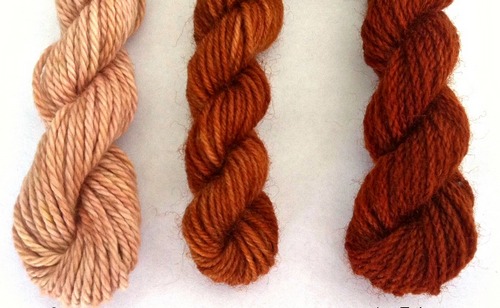
yarns. Various shades were obtained from the pre-mordanted wool yarn with alum
at different concentration.
The evaluation of colourfastness to washing
and light using alum as mordant is presented in table 4.1. At 3% concentration
of alum, washing fastness and light fastness was good. At 6%, concentration of
alum washing fastness and light fastness is same as that of 3% concentration of
alum. At 9 %, concentration of alum washing fastness was fair whereas light
fastness was good.
|
Table 4.1 Colourfastness properties of wool
yarn dyed with extract of dry outer onion skin using different concentration
of alum.
|
||||
|
Concentration
Of
mordant
|
Washing
fastness
|
Light
fastness
|
||
|
Rating
|
Remark
|
Rating
|
Remarks
|
|
|
100% CW
|
2
|
Poor
|
2
|
Poor
|
|
3%
|
4
|
Good
|
4
|
Good
|
|
6%
|
4
|
Good
|
4
|
Good
|
|
9%
|
3
|
Fair
|
4
|
Good
|
5.
Conclusion
A
global awareness is already in place favouring the use of natural resources for
protecting the environment and earth from pollution and ecological imbalances.
Hence, the present scenario is directed towards the utilization of natural
dyes. In present research work, it was found that wool could be dyed with dry outer
(papery) onion skin. Various shades can be obtained using chemical and mordant.
The parameters like concentration of dye, temperature and timing are also
optimised for better results. With regard to colourfastness, the tested samples
exhibit good fastness to washing and light.
References
- http://cdn .intechopen.com/pdfs/23051/In Tech- dyeing_of_textiles_with_natural_dyes.pdf
- Prabhu K. H. And Bhute A.S. A Review Journal of Natural Products and Plant Resources, 2 (6), 649-664, (2012).
- http://www.naturalsuburbia.com/2012/04/natural-dyeing-with-onion-skins.html
- VArun,PPRobinson,SManju,PLeeju,JVarsha,VDignaandKKMYusuff:Dyesandpigments;82(3), pp268-275, (2009).
- www.shearcomfort.com, Canes is Network Ltd, wool-The Natural Fibre.

No comments:
Post a Comment